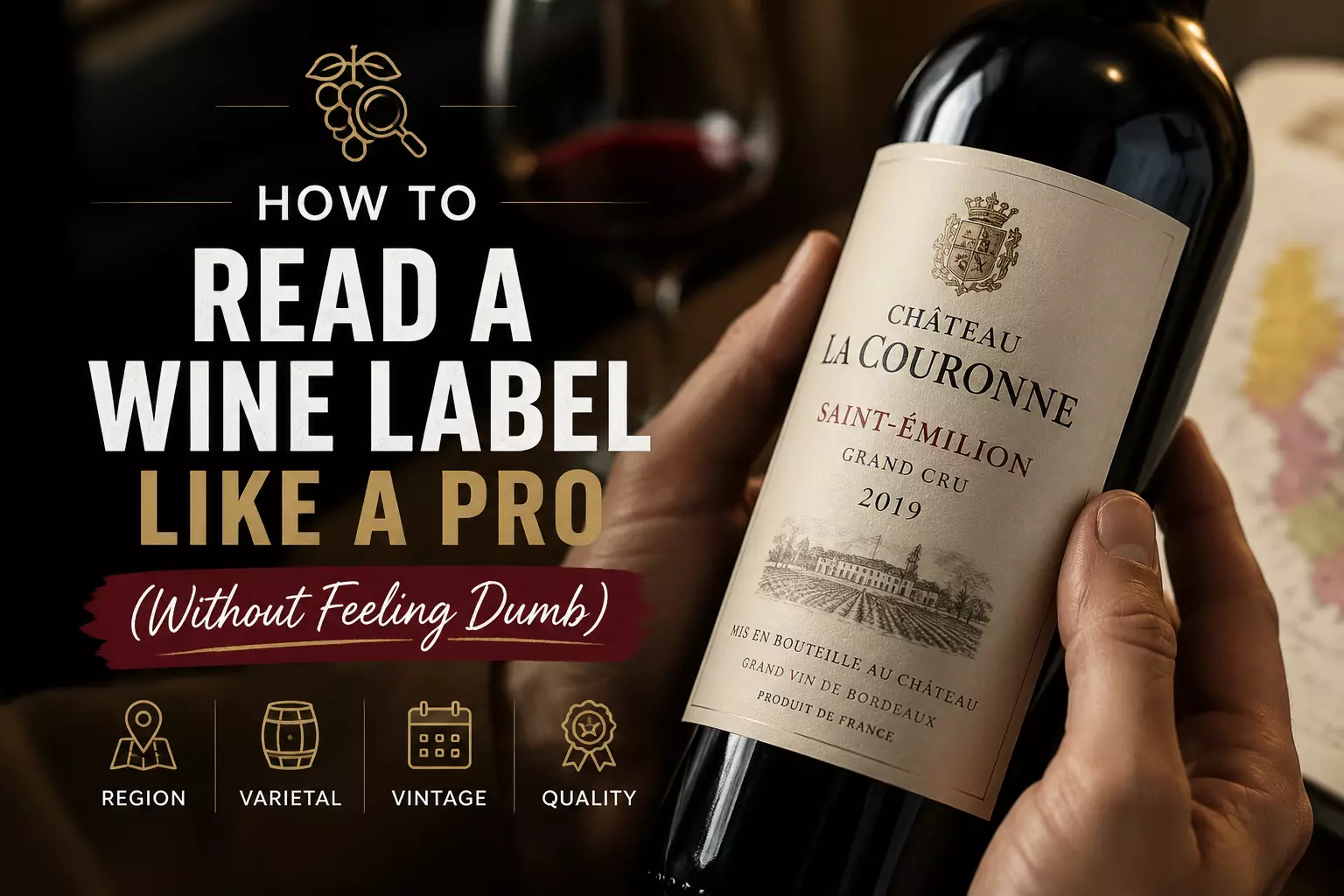
Standing in a wine shop aisle, holding a bottle with a label covered in French words, tiny print, and a crest that looks like it belongs on a medieval shield — that is a moment most of us know well. A 2019 survey by Wine Intelligence found that label confusion is one of the top three reasons consumers feel anxious about buying wine. The good news? Learning how to read a wine label like a pro (without feeling dumb) is far simpler than the wine industry would have you believe. Once you understand the basic structure of what goes on a label, every bottle becomes a readable story rather than an intimidating puzzle.
This guide breaks down every element of a wine label in plain language. Whether you are shopping for a dinner party, building a small collection, or just trying to stop grabbing the bottle with the prettiest picture, this article gives you the tools to decode any label with confidence.
Key Takeaways
- Wine labels follow a predictable structure: producer, region, grape variety, and vintage are the four core elements to find first.
- Old World labels (Europe) tend to lead with place names; New World labels (Americas, Australia, South Africa) tend to lead with grape names.
- The vintage year tells you when the grapes were harvested, not when the wine was bottled or purchased.
- Alcohol by volume (ABV) is a reliable clue to a wine’s body and style — higher ABV often means fuller body and riper fruit.
- The back label is your best friend: it often translates everything on the front into plain English.
The Four Core Elements Every Wine Label Contains
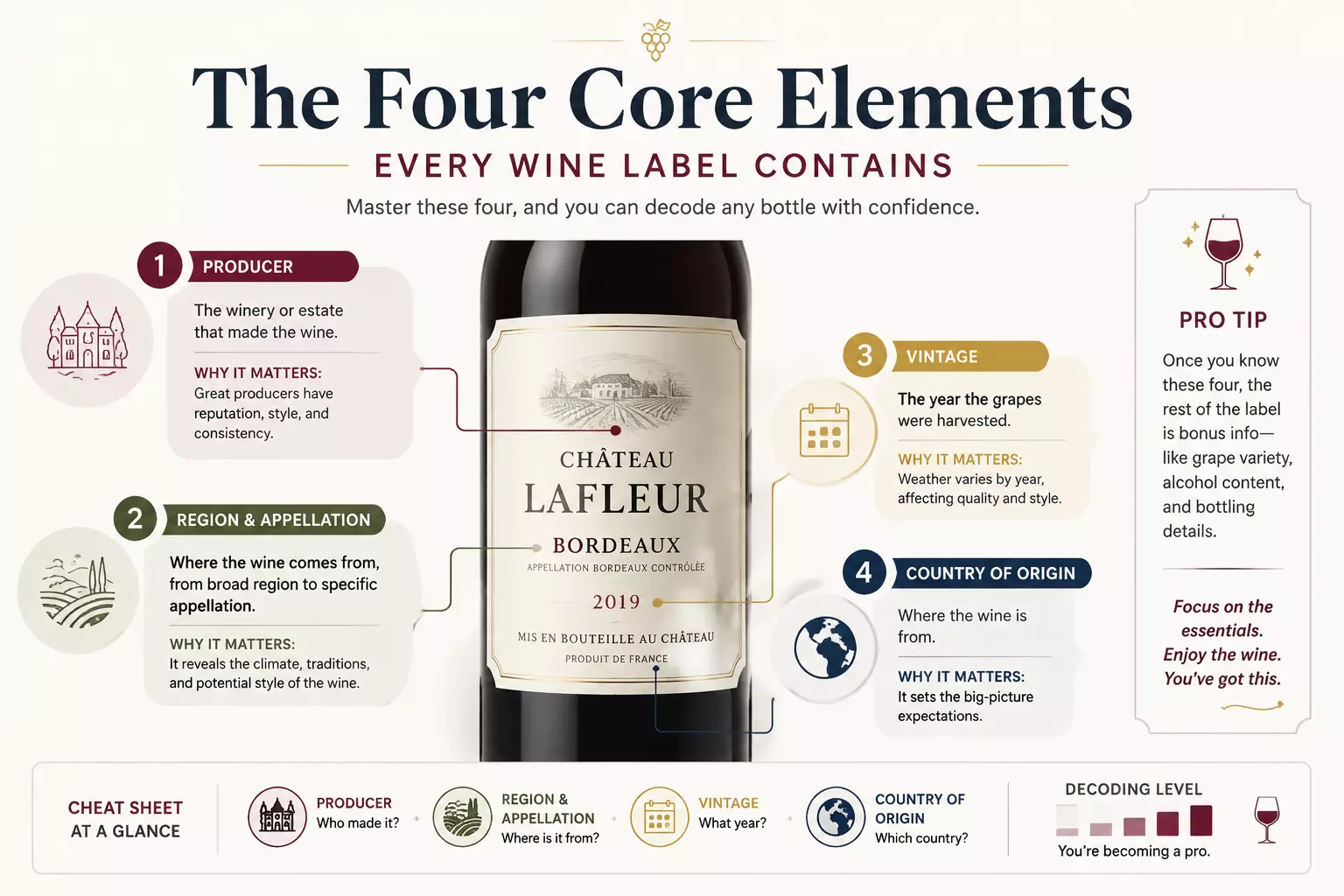
Before diving into regional quirks and certification seals, it helps to know that almost every wine label in the world contains four fundamental pieces of information. Think of these as the four corners of a map. Once you locate them, everything else is just extra detail.
The Producer Name
This is who made the wine. It might be a family estate, a large cooperative, a négociant (a merchant who buys grapes or bulk wine and bottles it under their own name), or a corporate brand. The producer name is usually the largest text on the label. In France, you might see “Château” or “Domaine.” In Italy, “Tenuta” or “Cantina.” In Spain, “Bodega.” In the United States, it is often simply the winery name.
Why it matters: Producers have house styles. Once you find a producer whose wines you enjoy, you can follow their other releases with confidence.
The Region or Appellation
An appellation is an officially recognized geographic area where grapes are grown. This is arguably the most important piece of information on an Old World label, because in countries like France, Italy, and Spain, the region dictates almost everything — which grapes can be used, how the wine must be made, and what style to expect.
“The place a wine comes from is not just an address — it is a recipe.”
In France, for example, a label that says “Burgundy” (or “Bourgogne”) tells you the wine is made from Pinot Noir (if red) or Chardonnay (if white), because those are the only grapes permitted in that region. You do not need to see the grape name on the label if you know the region.
The Grape Variety (or Varieties)
New World wines — from the United States, Australia, Argentina, Chile, New Zealand, and South Africa — almost always list the grape variety prominently. “Cabernet Sauvignon,” “Chardonnay,” “Malbec.” This is enormously helpful for beginners because it tells you directly what you are drinking.
Old World wines often skip the grape name entirely, assuming the buyer knows that Chablis is Chardonnay, or that Barolo is Nebbiolo. This is where many people feel lost, and it is completely understandable. A quick reference chart can solve this problem instantly.
| Old World Label | Grape(s) Inside |
|---|---|
| Chablis (France) | Chardonnay |
| Burgundy Red (France) | Pinot Noir |
| Bordeaux Red (France) | Cabernet Sauvignon, Merlot blend |
| Barolo / Barbaresco (Italy) | Nebbiolo |
| Chianti (Italy) | Sangiovese |
| Rioja (Spain) | Tempranillo |
| Sancerre (France) | Sauvignon Blanc |
| Alsace Riesling (France) | Riesling |
The Vintage Year
The vintage is the year the grapes were harvested. It is not the year the wine was released for sale, and it is not the year you bought it. A bottle purchased in 2026 might carry a 2022 or 2023 vintage — that is perfectly normal.
Why does vintage matter? Weather varies year to year. A warm, dry growing season produces riper grapes and often bolder wines. A cool, wet year can produce leaner, more acidic wines — which some people prefer. For everyday drinking wines, vintage matters less. For age-worthy bottles from prestigious regions, it can significantly affect quality and price.
Old World vs. New World Labels: A Tale of Two Philosophies
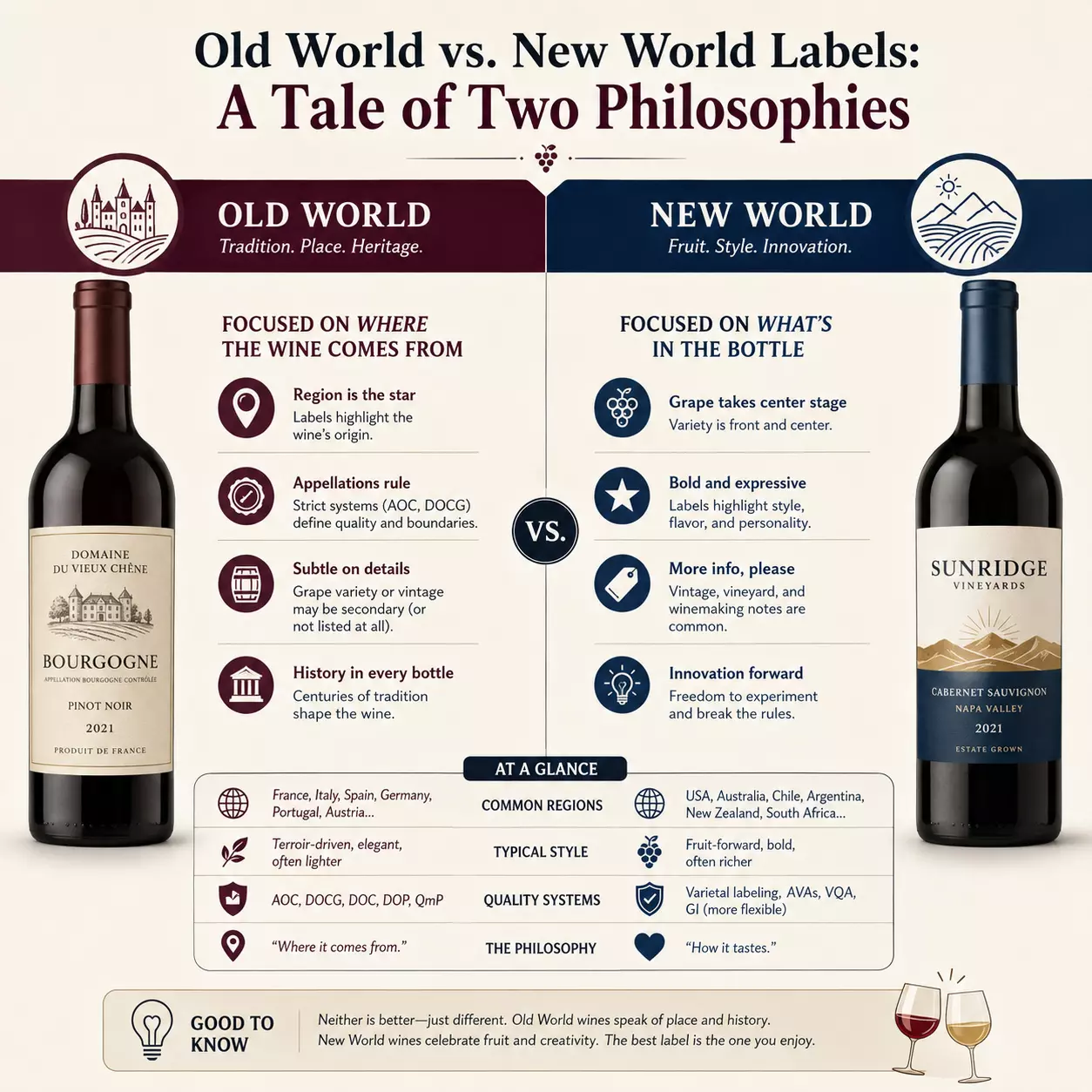
One of the most useful frameworks for learning how to read a wine label like a pro (without feeling dumb) is understanding the Old World versus New World divide. This is not just geography — it is a fundamental difference in labeling philosophy.
Old World Labeling: Place First
Old World wine countries — primarily France, Italy, Spain, Germany, Portugal, and Austria — built their wine identity around terroir, a French word meaning the combination of soil, climate, and geography that gives a wine its character. Their labels reflect this by leading with place.
When you see a label that says nothing but “Pouilly-Fumé” or “Priorat,” the producers are telling you: the place is the story. The assumption is that you know (or will learn) which grapes grow there.
Key identifiers of Old World labels:
- Region or village name is the largest text
- Grape variety is often absent
- Classification terms appear (Grand Cru, Reserva, Classico)
- Language is local (French, Italian, Spanish, German)
- Design tends to be traditional, often featuring estates or crests
New World Labeling: Grape First
New World producers — from Napa Valley, Marlborough, Mendoza, Barossa Valley, and beyond — took a different approach. They put the grape front and center because their markets, particularly in the United States and United Kingdom, were filled with consumers who did not have generations of wine education behind them.
This approach democratized wine enormously. Knowing that you enjoy Pinot Noir means you can pick up a bottle from Oregon, New Zealand, or Chile and have a reasonable expectation of what you will taste.
Key identifiers of New World labels:
- Grape variety is the largest or second-largest text
- Region is listed but secondary
- Tasting notes sometimes appear on the front label
- Design is often modern, bold, or playful
- English is the primary language
Decoding the Fine Print: What the Back Label Tells You
The back label is criminally underused by most wine buyers. I used to flip bottles over, glance at the back, and put them straight back on the shelf. Once I started actually reading back labels, my wine shopping improved dramatically. Here is what to look for.
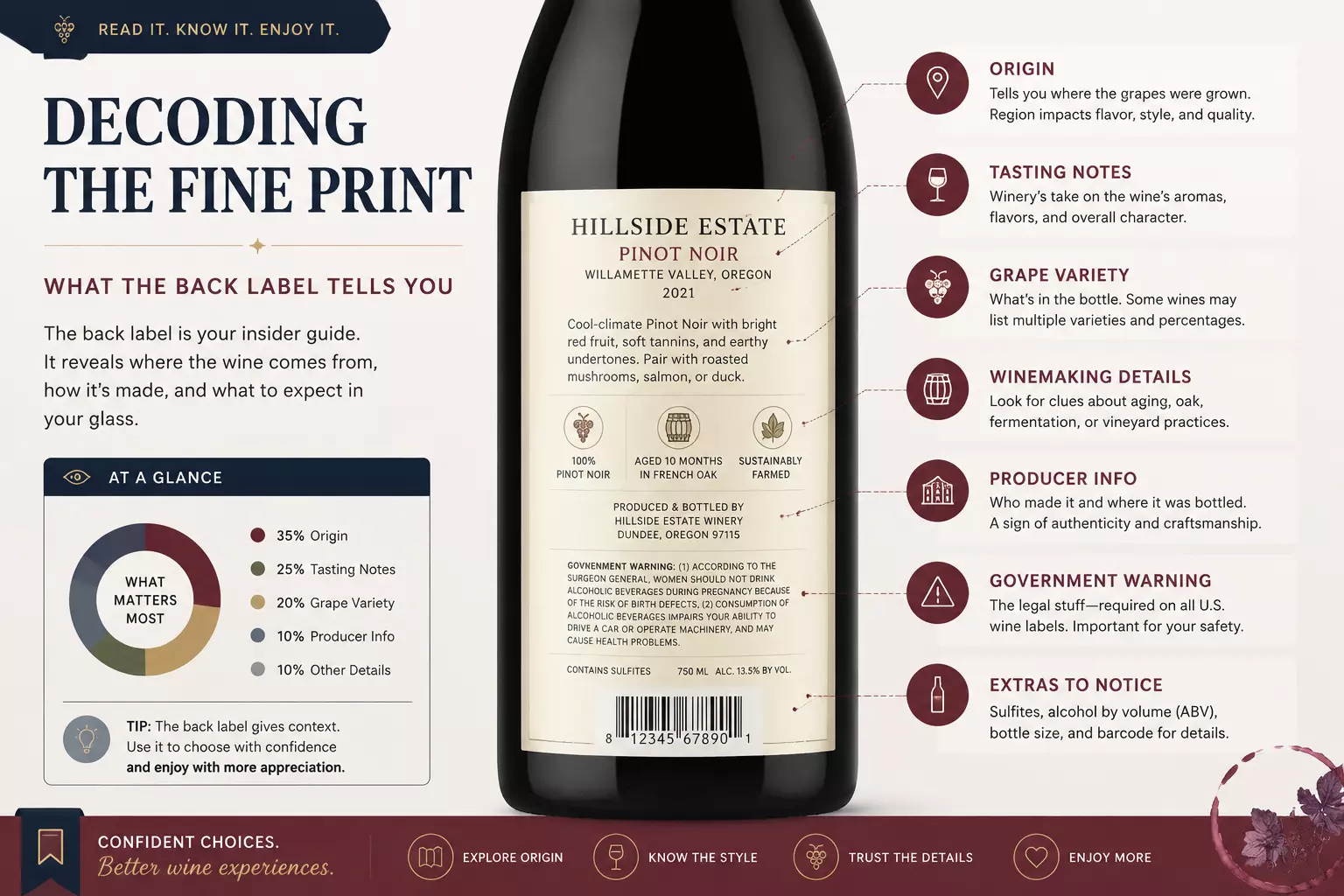
Tasting Notes and Food Pairings
Many producers include brief tasting notes — descriptions of the aromas and flavors you can expect. Phrases like “notes of dark cherry, tobacco, and cedar” or “crisp acidity with green apple and citrus” give you a preview of the glass. Food pairing suggestions are also common and genuinely useful, especially when you are buying wine for a specific meal.
Alcohol by Volume (ABV)
ABV is required by law on wine labels in most countries. It is expressed as a percentage, typically ranging from about 8% to 15.5% for still wines. This number is more useful than most people realize.
| ABV Range | What It Suggests |
|---|---|
| 8% – 11% | Light body, often off-dry or sweet (German Riesling, Moscato) |
| 11.5% – 12.5% | Light to medium body, often higher acidity (Pinot Grigio, Vinho Verde) |
| 13% – 13.5% | Medium body, balanced (many Burgundy, Rioja, Chianti) |
| 14% – 15.5% | Full body, riper fruit, warmer climate (Napa Cabernet, Australian Shiraz) |
Sulfite Information
Labels in the United States and European Union are required to state “Contains Sulfites” if the wine contains more than 10 parts per million of sulfur dioxide. Sulfites are a natural byproduct of fermentation and are also added as a preservative. Most wine contains them. The “Contains Sulfites” warning does not indicate a low-quality wine — it is simply a regulatory requirement.
Importer and Distributor Information
For imported wines, the back label lists the importer. This is actually a useful quality signal. Certain importers are known for curating exceptional portfolios. Learning the names of respected importers in your market can help you discover new wines with confidence.
Government Health Warnings
In the United States, all wine labels must carry the Surgeon General’s warning about alcohol consumption during pregnancy and operating machinery. This is a legal requirement, not a reflection of the wine’s quality.
Classification Systems and Quality Tiers: Reading Between the Lines
One of the most confusing aspects of wine labels — and one of the most rewarding to understand — is the classification system. Different countries use different terminology to signal quality tiers, and knowing these terms helps you understand what you are paying for.
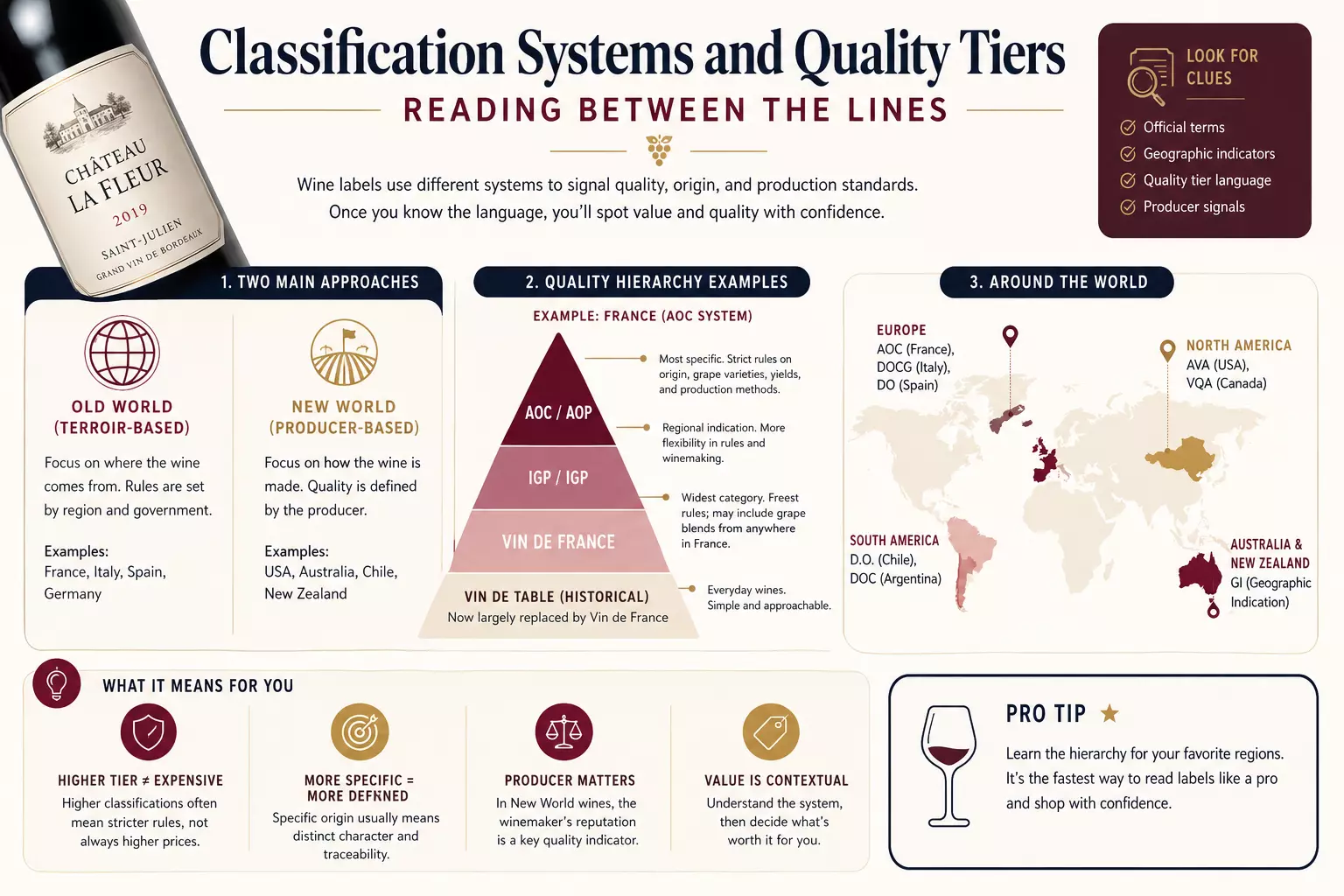
France: The AOC System
France’s Appellation d’Origine Contrôlée (AOC) system, now officially called AOP (Appellation d’Origine Protégée) under EU law, is the foundation of French wine regulation. Wines labeled with a specific AOC have met strict rules about geography, grape varieties, yields, and production methods.
The hierarchy in Burgundy, for example, runs from regional (broadest) to village to Premier Cru to Grand Cru (most specific and prestigious). A label saying “Gevrey-Chambertin Premier Cru” tells you the wine comes from a specific, highly regarded vineyard within the village of Gevrey-Chambertin.
Italy: DOC and DOCG
Italy uses a similar system. DOC (Denominazione di Origine Controllata) and DOCG (Denominazione di Origine Controllata e Garantita) are quality designations. DOCG is the higher tier, with stricter regulations and required tasting panel approval before release. Wines labeled “IGT” (Indicazione Geografica Tipica) have more flexibility — some of Italy’s most innovative and expensive wines, like the Super Tuscans, carry IGT designations because they use non-traditional grapes.
Spain: The Aging System
Spain’s labeling system is particularly useful because it tells you directly how long the wine has been aged. These terms appear on the label:
- Joven — young wine, little or no oak aging
- Crianza — minimum aging requirements (usually 2 years, including time in oak)
- Reserva — longer aging (typically 3 years for reds)
- Gran Reserva — the longest aging requirement, reserved for exceptional vintages
Germany: Ripeness Levels
Germany’s wine classification is built around the ripeness of the grapes at harvest, which correlates with sweetness potential. Terms like Kabinett, Spätlese, Auslese, Beerenauslese, and Trockenbeerenauslese (TBA) appear on labels and indicate increasing levels of grape ripeness. Importantly, a wine labeled “Trocken” is dry, regardless of its ripeness category — a crucial distinction for buyers who prefer dry wines.
Practical Tips for Reading Wine Labels Like a Pro (Without Feeling Dumb) in Real Life
Understanding the theory is one thing. Applying it in a busy wine shop or at a restaurant table is another. Here are the practical strategies I use every time I pick up a bottle.
Start With What You Know
If you enjoy a particular grape variety, start there. Find the grape name on the label — or use the Old World reference table above to identify it from the region. Build outward from your comfort zone one bottle at a time.
Use the Price as Context, Not as a Quality Guarantee
Price does not always equal quality, but it does provide context. A $12 Chianti and a $60 Chianti Classico Riserva are both Sangiovese-based wines from Tuscany, but the latter has stricter production rules, longer aging, and typically more complexity. The label tells you which tier you are in.
Look for the Vintage and Do a Quick Mental Check
For everyday wines under $20, vintage matters very little. For wines over $30 from regions known for vintage variation — Burgundy, Barolo, Bordeaux, Napa Cabernet — it is worth a quick mental note or a fast search on your phone.
Read the Back Label Before You Decide
Flip the bottle over. Read the tasting notes. Check the ABV. If the back label is entirely in a foreign language with no English translation, that is usually a sign the wine is made for export to a non-English market, which can sometimes indicate a more traditional, terroir-focused producer.
Trust the Importer’s Name
If you are buying imported wine and you recognize the importer as one known for quality selections, that is a meaningful signal. Develop a short mental list of importers whose taste aligns with yours.
Do Not Be Afraid to Ask
Wine shop staff exist to help. Telling someone “I like medium-bodied reds that are not too tannic, and I want to spend around $20” is all the information a good wine merchant needs to point you to something excellent. You do not need to decode every label yourself.
Common Wine Label Myths Debunked
Myth: A heavy bottle means better wine.
The weight of the bottle is a marketing choice, not a quality indicator. Some outstanding wines come in lightweight bottles.
Myth: “Reserve” always means something special.
In countries like the United States, the word “Reserve” has no legal definition. Any producer can use it. In Spain and Italy, however, “Reserva” and “Riserva” have legally defined aging requirements.
Myth: Screw caps mean cheap wine.
New Zealand, Australia, and an increasing number of premium producers worldwide use screw caps to prevent cork taint. Many world-class wines now use alternative closures.
Myth: You need to know French to understand wine labels.
A handful of key terms — Château, Domaine, Cru, Blanc, Rouge, Sec, Demi-Sec — covers the vast majority of what you will encounter on French labels. The same applies to Italian and Spanish with a short vocabulary list.
Myth: Older is always better.
Most wines — roughly 90% of all wine produced — are made to be consumed within three to five years of harvest. Only specific wines from specific regions benefit from extended cellaring.
Conclusion
Learning how to read a wine label like a pro (without feeling dumb) does not require a sommelier certification or years of study. It requires knowing where to look and what the key terms mean. Start with the four core elements — producer, region, grape, and vintage. Use the Old World versus New World framework to set your expectations. Read the back label every time. And use the classification and ABV clues to understand style and quality tier before you commit to a purchase.
Actionable next steps:
- Next time you are in a wine shop, pick up three bottles from different countries and practice locating the four core elements on each label.
- Save the Old World grape reference table in your phone for quick access.
- Ask your local wine merchant to recommend one Old World and one New World wine made from the same grape variety, then compare them side by side.
- Pay attention to the importer name on bottles you enjoy — it will become a reliable shortcut.
- Keep a simple wine journal: write down the producer, region, vintage, and your impressions. Patterns will emerge faster than you expect.
The label is not a barrier. It is an invitation. Once you know how to read it, every bottle becomes a conversation worth having.